

Community-led monitoring has a significant impact on ensuring quality care and treatment services in the respective health facilities. Service recipients’ opinions on the quality of the service they receive or the kind of services they demand and service providers’ provision or inaction of the service create more confidence in service users and increase uptake of the respective service. This has been evidenced by initiation of PREP service at Salawe health center in Shinyanga DC that resulted from number of service users’ opinions during data collection by community monitors.

One of the findings of Community-led monitoring was unavailability of Prep services at Salawe Health center. Clients were not aware of the service and they none of them confessed to get the service and even service providers confessed that there was no Prep service at their facility. Considering Prep is one of the potential services in preventing new HIV infection, TAI presented this finding during the quarterly meeting with CHMT of Shinyanga DC. And District AIDS Coordinator (DAC) responded that the vendor was in place though the service initiation has delayed.

The situation was the same and during the quarterly meeting it was insisted that this should be taken more seriously being taken into priority actions for the quarter for service improvement by CHMT, for the first time PREP services were initiated at Salawe health center. We happy that through Community-led monitoring we have fastened the initiation of Prep services at Salawe health center. Some of the community monitors confessed that community Led monitoring project has improved their confidence when the provide service to clients and improved their relationship because they have witnessed their feedback/opinion being worked on.
Ester (not real name) is the third born among 8 children of Mr. and Mrs. Fabian Makeja who live at Mwalukwa village in Shinyanga District. She is currently a form one student at Rugambwa girls’ secondary school (special school for gifted girls) located in Bukoba Municipal selected after performing well in her 2019 primary school national examination sat at Mwalukwa primary school. She is one among many girls who are struggling to fulfill their potential and live their dreams despite the difficult life in her family. She believes education as a tool to liberate her family from poverty in a near future.
“I want to be a social worker who will support children and girls in needy in my community just as Ellypendo (Ward Community Development Officer) who is educating us on child rights and the effects of getting married at the young age. When I grow up, I want to help many more children mostly the vulnerable girls who are at risk of child marriages and pregnancies to reach their full potential”
Ester was one among of the girls who participated actively in school club established by Thubutu Africa Initiative (TAI) at Mwalukwa primary school. In the school club they usually learn on their basic rights as children, social life skills and Sexual and Reproductive Health and rights.
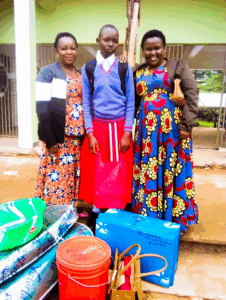
Ester’s family was identified as one among the vulnerable households with girls at high risk of child marriages and pregnancy. Her family benefited with a goat from Ending Child Marriage project as a means for household economic strengthening. Her mother proves their vulnerability as she says:
“I thank God that Ester has passed her exams well and prove me in laws wrong because last year (2019) they were forcing me and my husband to stop Ester’s sister from going to school so that she can get married, they even dared negotiating for her bride price but we as parents refused and they said they won’t support us in girl’s education because it is useless as she will later get married and benefit another clan/family. So even when we told them that Ester has passed and she is supposed to go Rugambwa secondary school and requested their support, they refused.”
Ester’s parents did not know where to get support for their daughter’s education, they confronted Ellypendo, Ward Community Development Officer and said we have a goat which was granted to us by TAI but we can’t sell it now to support Ester’s education because it is supposed to reproduce and be a source of income but if we sell it know it will be against the intension of the project. She almost missing the opportunity to join her secondary education as her family was unable to support her till when Thubutu Africa Initiative took the role to support her education.
“My father’s family does not believe in taking girls to school, they say only boys have to be taken to school. My sister Debora (not real name) was forced to stop schooling and be married so that the family may get dowry (cows), but our parents refused and they stopped supporting my parents on our education expenses When Thubutu Africa Initiatives supported our family with a goat It gave me strength to study hard because there are other people than my father’s family who can support us to achieve our dreams.”
Despite the financial challenges her family faces, Ester did not give up, she studied hard and did well in her primary education. She believes that she will reach her full potential and liberate her family from poverty.
She is thankful to TAI and Ending Child Marriage project that offered her a reason to study hard and achieve her dream. She wants the community to change their attitude, and perception on girls’ education and that both boys and girls are equal hence they deserve equal rights.
Some of girls from Pandagichiza secondary school have been experiencing assault from male teachers several time. Most of them due to fear of undermarked or corporal punishment they opt to do what male teachers required from them (Marking sex). The story is about one of the victim a senior three students who experienced it whereby she was used by her teacher for the fear of corporal punishment and favor in examination. After receiving training, she gained confidence which enabled her to solve the situation of being used by her teacher for granted.
As a result of training, girls were equipped well and become more confidence and they were able to speak out for themselves without any fear. Through training number of girls who have been experiencing the same challenge at school confessed that the situation has reduced. They are no longer fear to share with their friendly or any other person they trust for the purpose of seeking help. This becomes one way of reducing violence among secondary school girls. Through “Shule Salama Kwa Wote” girls were equipped with skills concerning all categories of violence and were to report those cases in case of any. Trainers also instilled a sense of emancipation among girls. This helped in conquering fear among girls to be able to fight for their rights and fight for other girl’s right who could not speak out because of fear or shame.
Girls from Pandagichiza secondary school benefited from the training. Through the skills they gained from the project they are now able to speak out for themselves without any fear. They can also fight for others who still fear to speak out because of shame. Male teachers no longer use girls for granted, through this project schools are now safe place for them to learn where VAS especial sexual harassment, torturing among girl students has reduced which led to increase in knowledge, skills, behavior change and power of making personal decision among girls. As a result of being equipped they managed to handle other teachers who had the same habits. By being knowledgeable girls from Pandagichiza secondary school they become a change to other and knows their rights. Those who were trained they are still motivating others even those who are outside school environment hence reducing violence among young girls.
According to the current interview conducted at Pandagichiza Secondary schools, girls are now very confident and they no longer fear to report any case of violence either from school, home or any other settings. Most girls now know where to report cases of violence and also, they do report those who violate the right for girls. According to a senior three girls she started that “Before the training a male teacher used to take me for granted because he was aware that there is no any place I can go and report the case. But after the training I was able to talk to him wherever he wanted me for sex and told him that I have a right over my body and I know places to report in case of any violence. Since that time, I am free from discrimination against all sort of violence at school, home and market. When the teacher was doing that kinds of behavior she was refused and not be able to
“Seasonal farming is agricultural that prevents me from achieving my goals because the problem of lack of reliable water makes me unable to fulfill and achieve the goals, I set for myself, this is due to farming using the rain that falls season after season” the words of Nshoma (Not her real name).
For the last 5 years, we have been doing vegetable farming depending on the seasonal rains, this has led to a period when the rain stops, we have been going through a difficult period because the income we get during the rainy season cannot be sufficient to be used also when the rainy season is over and so leading to living a difficult life if it is Along with going through the challenges of harassment from our men, the environment we live in, failing to serve the family if it is Along with providing it with the necessary needs and thus making us sit and wait for another rainy season to start so we find ourselves increasingly weakened in a heavy wave of poverty in every sphere.
Drilling a well is a sufficient solution for us to get rid of this challenge of relying on the water during the rainy season because the presence of this large well with the ability to provide a lot of water to meet our needs is a good solution for us. The presence of this dug as well as its various infrastructures such as modern water pumps, the presence of a water storage tank, the electrical system, and the management of this project will eliminate this problem of us, as a mothers farming by relying on rainwater only.
In general, the presence of this well in our community is a great contribution to achieving our success in various life aspect, these including economic, social, and even for our development. A total of 50 mothers (women) will be able to benefit from this modern well project and this will lead to employment opportunities for various groups around our society. Through this well will make us mothers to be able to farm all the time without getting stuck or stopping due to lack of water, but this well makes us able to grow vegetables without limit and this allows us to produce quality and marketable products because we depend on this farming. The (women) mothers were able to say that the results of this project will increase the income of each person and lead to have a strong economy and being capable to obtaining basic needs, increasing other sources of income, improving the quality of life, promoting and strengthening the household economy and development in general. “Minza (not her real name) added by saying that we are very grateful for the help we got because the benefits we will get here are not for us but for our community, our families and our life as a whole because we were doing horticulture for some time if water is available but for now we can do it within any time we see fit to do farming without waiting for the availability of water.
This project gives a wide range for these (women) mothers to be able to increase their income individually and even for the group as a whole and this will also affect the family level because that is where changes will occur if it is Along with increasing the family’s income from a certain level to a certain level, the ability of the family to be able to get important social services, including food, shelter, health services, and other important services according to the future of each person’s life. But it also provides an opportunity to expand and have a greater production capacity and also to be able to find other markets for selling products from the garden.
Thubutu Africa Initiative – TAI successfully and managed to facilitate the construction of a girl’s toilet at Lubaga Primary School at Shinyanga Municipal in Lubaga ward by using human, financial, and material resources which were organized by the mobilization team through community giving. The coordinating team managed to spread the idea of community philanthropy within and outside of the Shinyanga region using different social media like radio, Facebook, Twitter, and blogs among others. Community members appreciated the innovation used since the project was accomplished timely and they encouraged the team to conduct different projects by using the community philanthropy approach since it is one way of ensuring sustainability, accountability, transparency, and commitment which made community members feel part and part of the project. TAI is now a pioneer of community philanthropy and most civil society organizations learning from TAI on how to implement different projects in their localities by using local giving which has increased the value of community resources in project implementation.
Community members raised a challenge of increased school dropout and poor performance among school girls of standard 5 to 7 because of poor latrines at school. There were few latrines compared to the number of girls and they were very old without changing rooms which discouraged them, especially during their menstruation. This made most of them drop out of school which made community members come up with the solution of constructing latrines with changing rooms to reduce the cases of school dropout and poor performance among girls. The selected team for resource mobilization conducted several meetings at school and all streets around the project area which were fruitful. The team also used the door-knocking method and this was done by moving to different stakeholders and community members like businessmen, government and private institutions, and individuals looking for resources. This helped to increase understanding of community philanthropy ideas since most of the community members who did not attend the meetings that were organized, were reached in their working sites.
Since the community philanthropy project is voluntary, community members were free to pledge anything that they were sure of despite the size and we were focusing much on materials since it was easy for the community to give out materials compared to money because this was the first project to be implemented through community philanthropy approach and most of the community members wanted to first prove if the project will be successful through the stated approach and this made them to be willing to provide material and manpower support compare to financial support.
| · 89% of the material used to accomplish the project was direct from the community. This evidenced that community members are ready to participate in solving their problems. This was due to the full involvement of community members in project design, planning, and transparency of the committee team during and after resource mobilization.
· Community members were able to use the available resources within their localities to address the identified challenge. Since it was a community project, communities were free to give out materials without considering the ratio and size as long as it was building material the committee welcomed them and this made them feel free to donate even the material in which they were using in their sites. · The participatory approach puts community members at the front-line during project implementation. This made them feel part and partial of the project since they were involved from the initiation stage and the team was giving out feedback on each step during project implementation. · Through the project introduction meeting, community members became very positive about the approach to be used and ready to participate. Because they were the ones who selected the fund fundraising team, they had trust in them as they were capable of conducting the project successfully.
|
| · Community philanthropy is voluntary, when the community is aware they are ready and proud to engage in their development. Community members were free to pledge whatever they had, willingly and in their own time as long as it was within the stated period of implementation and this made them donate as much as they could no matter the stage of the project.
· Accountability and transparency are key in implementing community philanthropy projects. This helps community members to know the value of the material they had contributed and how they were used. · Every resource is valuable in the community despite how small or large, and every contribution is a resource not necessarily a financial resource. Community members were free to donate whatever they were willing to give as long as it could be used to accomplish the project. · Through community engagement, project ownership and sustainability are ensured. This helps even after project termination; the community will be free and willing to do any renovation when required since they own the project.
Recommendation
Engagement of community members in problem identification, project designing, and planning helps in smoothen resource mobilization process and ensure project ownership and sustainability. This makes them to be aware of all necessary resources required and their values in every stage of project implementation. |
Girls from Palm Secondary school have been assaulted by their male teacher by telling them that in case if they refuse to do what he asks from them he was going to fail them in his subject because his subject was the tough one. Because of the fear they had to accept what their teacher was asking from them.
After receiving the training, they got confidence to say no wherever the teacher needed them. And they told him than in case if he continues to disturb them, they were going to report him to WEO so since then those students are safe and they are not afraid of saying no to anyone despite of age and their status.
As a result of training, cases of assault are now zero at Palm secondary school and they were also able to rescue those who were almost becoming victim of assault in a very school because they become the role models to others who were about to face the same trouble